Greenwich is the ‘home of communication’.[1] This phrase has been used in connection with the massive telecommunications cable industry in Greenwich and Woolwich. However if communication is a means of passing messages between people there were clearly older methods of doing this and they too have a relevance to Greenwich and in particular to Shooters Hill.
Perhaps one early indication of this is the formation in 1513 of a guild of mariners who wanted a fraternity to regulate pilotage on the River. [2] In 1514 they received a charter as the Guild and Brotherhood of the most Glorious and Undivided Trinity of Saint Clements in the parish of Deptford Strond in the County of Kent. Thus Trinity House itself was formed locally and continues to undertake work to reflect its original aims around the safety of mariners – and this clearly involved means of passing information at sea and on the river. We will return to them.
William Lambarde was the Kentish historian after whom Lambarde Wall in Charlton is named and who was a Greenwich landowner. His ‘Perambulations of Kent ‘published in 1570 mentions a beacon on Shooters Hill. Although for Lambarde this was a new and important means of communication, as a historian he knew that beacons were a much older technology and he mentions that the word ‘beacon’ itself has Saxon roots. He says that before the reign of Edward III they were made of stacks of woods but that more sophisticated methods had been developed using a pot of tar on a high pole. It is also clear that by the 16th century use of beacons was well known, and in localities, there was organisation and people who knew what to do and how to do it. The accounts of the Eltham churchwardens give details of payments for watching the beacon at Shooters Hill in the 1560s and 1570s [3]
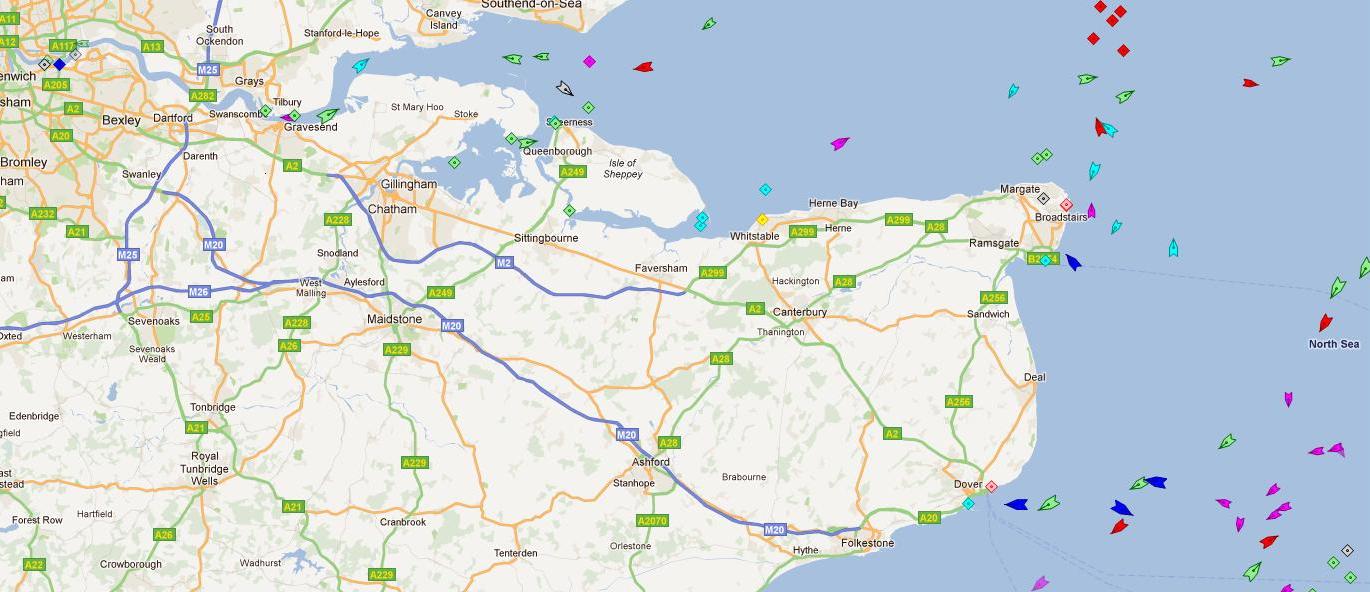
In 1566 The Seamarks Act enabled Trinity House to ‘make direct and set up ...... beacons, marks and signs for the sea’. Most famously in 1588 a chain of beacons were set up for the Spanish Armada by which the first sighting on the south coast could be relayed as a message to the London in half an hour. Lanmbarde’s map shows announced that Kent beacons were aligned so as to relay the messages to eventually reach Shooters Hill and it is possible the other county network also ended there making Shooters Hill the pivotal point for relaying information on to London. [4]
Eventually the fire beacons were replaced by mechanical devices. I n 1795 Lord George Murray, , proposed a system of visual telegraphy to the British Admiralty using a rectangular framework tower with six, five feet high octagonal shutters that flipped between horizontal and vertical positions to signal. This was set up in September 1796 London to Deal, with Shooters Hill lying between New Cross and Swanscombe. Messages from Deal could reach London in about sixty seconds. Later, a simpler semaphore system invented by Home Popham was used. This was a single fixed vertical 30 foot pole, with two movable arms attached. A line was set up between the Admiralty and Chatham in 1816 as an experiment. [5]
Later, a simpler semaphore system invented by Home Popham
was used. This was a single fixed vertical 30 foot pole, with two movable arms
attached. A line was set up between the Admiralty and Chatham in 1816 as an
experiment.
The Shooters Hill telegraph was in the Hazelwood’s Fields, later
called Telegraph Field.[6] It is now the site of the Memorial
Hospital. The earlier Murray telegraph
can be seen in a print by Robert Pocock of a hanging on Shooters Hill.[7]
Another telegraph in the area of Greenwich Borough was at Coxe’s
Mount in what is now Maryon Park, Charlton. It can be seen marked as
‘Telegraph’ on the 1866 Ordnance map. It
connected to the Shooters Hill telegraph station but its use and any subsequent
station of which it connected is not clear. Was it able to signal across the
river? Or was it used by the Royal
Dockyard and the military in Woolwich?
It is said had an adjacent wall with a line of large letters shown on it
which was used by the Admiralty Compass Laboratory which stood at the back of
houses in Maryon Road and was reached, presumably, by what is now Hawkins Terrace.[8]
As mechanical signalling systems were developed so scientists
are becoming aware that electrical systems were a possibility and some experiments
were carried out in our area. Many
sources reference what they say it was an attempt by Richards Watson, Bishop of
Landaff, to research electrical transmission at Shooters Hill.[9] This is almost certainly untrue and the experiments
were actually carried out by a William Watson with the Royal Society in 1747.
In August 1747 a group of Royal Society members met William
Watson at Shooters Hill and stood at the seventh and ninth milestones holding
iron rods.[10]
They were connected to a battery in a house on the hill and the idea was to see
if they would feel that the shock from it. A year later this was replicated.
They did feel shocks after some adjustments and the experiment was seen as a
success.[11]
We must keep in mind that signalling of all sorts was very much
the business of military and naval operations.
Telegraph systems were set up by the Admiralty and there is clearly a
long history of communication within the Royal Navy based on flags, in systems
codified in the late 18th and 19th centuries.[12] It is however unthinkable that there was not
some research by scientists and technicians at the Royal Military Academy and by
the Royal Engineers in Woolwich.
In the Royal Engineers a key figure in introducing flag signalling into the army is General Sir Charles Pasley who was a pupil in Woolwich at the Royal Military Academy from 1796 and who was to work closely with the Admiralty. Transferred from Woolwich he was responsible for the setting up of the First School of Field Instruction as a joint effort of the Admiralty and the Royal Engineers in Chatham Dockyard in 1812 and the beginning of communications technologies in the Royal Engineers and what became the Royal Corps of Signals. [13] Pasley was also closely involved in the development of signalling systems in the early railway industry, notably initially in the London and Greenwich Railway.[14]
There were many researchers who contributed to the development of the electric telegraph and several were part of the Royal Military Academy. Faraday himself held an appointment there as Professor of Chemistry. Another staff member was Peter Barlow who also made a number of experiments and investigations into electro-magnetism. A key figure in the development of the electrical telegraph was however an ordinary private soldier in Woolwich. William Sturgeon was a shoemaker from Lancashire who enlisted in the army in 1802. His spare time experiments in atmospheric electricity gained the attention of students and professors at the Royal Military Academy. In 1820 he left the army and set up as a boot maker in Woolwich and was a founder of the Woolwich Literary Society. He was later appointed to an academic post in the East India Company College at Addiscombe and subsequent appointments in Manchester.[15] Sturgeon developed a range of ground breaking electrical devices among them an electro magnet which became a basis for the development of electric telegraphy.
It is however in the more practical field of telegraphy that Greenwich and Woolwich factories were better known in the dominance of Telcon[16] and Siemens. Cable making grew out of rope making and the Enderby Brothers with their rope works at east Greenwich were well known. In 1837 William Cooke, the pioneer inventor of the telegraph approached Enderby Brothers for help in making insulated rope, this was said to be for a ‘cross Thames experiment’.[17] It is not known if anything came of this and it would be amazing to find that some of the earliest telegraphs used products from this site which was to become so famous in this field.
Over the next few years telegraphs were set up on the railways and companies began to sell telegraphs commercially. Following an agreement between the South Eastern Railway and the Astronomer Royal Greenwich Mean Time was transmitted to the provinces. On the roof of the English and Irish Magnetic Telegraph Company’s offices in the Strand a time ball was erected and electrically linked to the time ball at the Greenwich Observatory so that they fell at the same time. As a result of these initiatives Greenwich Mean Time was sent all round the country.[18]
If telegraphy was to become international then a way had to be found to lay cables across oceans. Various ways of protecting the cables were tried and an eventual solution discovered in the use of gutta percha – a natural substance obtained from a tree growing in south east Asia. It was handled and exploited through the Gutta Percha Company based in Islington. In 1850 a cable was laid between England and France. It wasn’t very good but things could improve.[19]
William Kuper was a wire rope manufacturer, based on the Surrey Canal in Camberwell. The firm became bankrupt in 1849 and a George Elliott became their agent and manager. He moved the works to Morden Wharf in Greenwich having got an order to armour the submarine cable laid in the Dover Straits in 1851.[20] Elliott was a mining engineer from the north of England where he was a major figure, to become MP and a baronet.[21] Having taken over Kuper he asked a Richard Glass to co-operate with him. Glass was an accountant, also a future MP and knight. [22] Kuper’s became Glass Elliott.
A number of works had been involved in the manufacture of submarine cables, most successful were Newell’s at Gateshead. Gradually the construction of cables was improved. In Greenwich Glass Elliott, now on Morden Wharf began cable manufacture. An innovation was to store cable in circular water filled pits. Gutta Percha was supplied from Islington.[23] Telegraph companies were formed, cables were made and successfully laid and Glass Elliott were in the forefront.[24]
In 1854 Glass Elliott bought the site of the now defunct Enderby canvas and rope works.[25] It came with a deep water wharf and an existing rope walk. In 1857 they were visited by William Thomson, future Lord Kelvin, representing the new Atlantic Telegraph Company. There was serious money behind the proposed cable to cross the Atlantic, and the cable, of an enormous length, needed to be perfect.[26]
The laying of the Atlantic cable is one of the big romantic stories of the mid 19th century. It was followed closely by the press and there are many many illustrations. “I did cheer but I could more have silently cried. They may, long after we are gone, tell their children what we did’.[27]
The first try to lay the Atlantic cable was in 1857. The core was made at the Gutta Percha works and the cable itself divided between Newalls and Glass Elliott and it was laid by two old war ships. The cable broke they tried again and it worked for a bit, and then failed.
It was eight years before they tried again, and by that time Newalls were no longer interested and all the cable was thence made in Greenwich. In 1864 Glass Elliott and the Gutta Percha Company merged to become The Telegraph Construction and Maintenance Co. – Telcon. At Greenwich large underwater tanks were built at Enderby Wharf to store the cable under the direction of William Thompson.[28] They approached the Atlantic Telegraph Company and it was agreed to try again.[29]
For this third try it was agreed that the cable needed to be laid in one continuous length – but the size and weight of this was enormous. It happened that Brunel’s vast Great Eastern was doomed as a failure and available. They bought her at a knock down price. She could not only take the cable but provide a lot of space for workshops and laboratories as well as many passengers. The cable was loaded from Greenwich onto a hulk and transferred to Great Eastern off Sheerness. Despite all the care that went into laying the cable a fault developed and the cable was broken and there was no choice but to abandon the attempt.[30]
In June 1866 Great Eastern left again for the Atlantic and as she
went bands played ‘Goodbye Sweetheart’. This time everything went smoothly and
on the 27th of July she arrived at Heart’s Content to cheering
crowds and a salute fired by all the ships n the harbour. The cable had been
laid.
Great Eastern then went back into the Atlantic to look for the
broken cable from the 3rd attempt. When the instruments at Valentia began to move
they showed that the broken cable had been found in mid Atlantic, spliced, and
that there was now a second functioning cable.
perhaps the point is that that those instruments were able to tell both
Europe and America what had happened and the information revolution was in
progress.
Today we take international communication for granted. on the Internet we receive instantaneous connections
to America and other countries all round the world and we think nothing of it.
It all happens because of the research and development in the technology of
underwater cables, much of which research was done in Greenwich. To outline the history of this site after
1865 is to give a long succession of technological breakthroughs and
success. Clearly the cables we have
today are nothing like those of but it has been research here which has
designed these changed. The factory itself has gone through a succession of
changes in ownership and those owners have had other sites where research and
manufacturing have been part of the changes. The Greenwich site survives.[31]
In addition the Greenwich site has remained a manufacturing base
which for many years up to the 1920s was making the vast majority of cables
which went under water round the world. They
continue with devices which enable and enhance transmission. For many years cable
ships regularly called at Enderby Wharf to load cable. The last was the John H. McKay which was
retained as a monument for some years and what now remains is the equipment on
the Enderby jetty used for more transmitting cable on to the ships.
Today the site is a housing estate although Alcatel still
undertakes research and some manufacturing on what was the Blackwall Lane end
of the site. A local group is working to
try and get some heritage input into the future of the estate in Enderby
house. To return to 1865 and Great Eastern
it may also be of interest that an attempt is being made to turn Heart’s Content
in Newfoundland and Valentia in Ireland into a sort of joint World Heritage
Site.
However the factory at Enderby Wharf was not the only research
based works in the Borough enabling innovation in telecoms equipment.
William Siemens had come to England from Prussia in 1843 to
develop his inventions in electrical engineering.[32] His brother Werner had
already founded Siemens and Halske in Berlin and was making telegraph
cables. William opened a factory in
Woolwich in 1863 to work with his brothers on cable making but by 1873 the Woolwich
factories were independent with a site covering four acres and a workforce of over
2000. They were to design their own
cable laying ship in 1874, the Faraday. They also moved into other electrical engineering
fields with initiatives like electric arc steelmaking and expanded the Woolwich
site with a chemical department and its own central electricity generating
station, the first in a British factory.
By the 1890s Siemens probably accounted for a third of total British
electrical and telegraphic production. in 1891 they made the first vast British
submarine telephone cable and from 1903 they made batteries and telephone line
material. Materials were transferred round the site by an electrically driven
overhead transit system. in 1900 the motor and dynamo departments moved to
Stafford and buildings were converted to make paper insulated cable and
insulated wires for a wide range of applications. The site continued to grow
with huge amounts of manufacturing capacity, office blocks and amenity space. In
1913 the firm took out a patent for the first British telephone exchange thus
cutting it reliance on the Berlin works. They also began to make and assemble
telephones.
During the Great War links with Berlin were further reduced but otherwise
work continued. field telephones became an important part of manufacture. After
the War there was an increase in work with a junction box factory added,
increased manufacture of ‘candlestick’ telephones and of batteries. There was also a return to submarine cables. In
1930 the neophone was introduced, [33]replacing the candlesticks
and these were made exclusively at Woolwich. In the late 1930s submarine cable
work and was transferred to Greenwich following a merger with Telcon
In the Second World War the Siemens factories were heavily bombed.
wartime work included the Clyde Loop. a submarine suite cable designed to pick
up on magnetic bombs. The firm was also used to design and manufacture the HAIS
cable laid across the English channel as part of the PLUTO operation in 1944.
After the war they concentrated and telecommunications and
engineering including a new instrument factory and marine radio school with a
special building used for training in the use of radar. [34]
The company had undergone a final disengagement from its German roots
and in 1954 was taken over by Associated Electrical Industries in creating
Siemens Edison Swan in 1957. in 1967 this was taken over by General Electric
Company by which time the Woolwich Factory was mainly involved in making Strowger
telephone exchanges for the Post Office. GEC was unwilling to invest in modernisation
and closed the Woolwich Works in 1968. [35]
Siemens works was replaced by the Westminster Industrial Estate,
plus some demolitions for the Thames Barrier and many buildings remain.[36]
A much smaller site adjacent to the Siemens works was the General Post Office cable depot which dated from the 1880s and was used by the newly nationalized Post Office to store cable before it was taken out to sea. It is said huge cast iron tanks survive in site. It was used until 1970s and is still called ‘Cable Depot’ although now consisting of light industrial units.[37]
It’s my perhaps be important in terms of market communication trade center of shooters hill and some other end east of the seventies there uncovered by local blogger.
He/she notes
many communications masts which are mobile phone or emergency service
communication masts, including the one on the old fire station in Eaglesfield
Road and mobile phone antennae attached to the 29th century Water Tower on the
crest of the hill. There are also others for taxis or the ambulance service. A
mast Foxcroft Road is for FM and DAB radio. The Port of Lojdon Authority had a
mast just off Shooters Hill Road for their Automatic Identification System
which identifies and locates ships around
the world and also has a direct microwave link to thePLA Vessel Traffic
Services radar station at Blackwall Stairs. They also note that the Ham Radio
Cray Valley Radio Society have been
known to hold meetings in the Bull, apparently
the highest pub in South London.
As the blogger points out, there will be more to come.[38]
[1] This was the title of a booklet produced by Alcatel in 2000 about their work
[3] White. The Beacon System Kent. Arch Cant 46 1934
[4] White
[5] http://e-shootershill.co.uk/2011/12/02/seven-centuries-of-signalling/
[6] https://www.ldwa.org.uk/ldp/downloads/TimeballandTelegraphTrail.pdf
[7] This is reproduced on the e-shootersill site web site, and elsewhere. There are many collections of Pocock’s prints but the actual location of this one is unknown to me.
[8] A visit to the Compass Laboratory. Household Words. Vol. 3 1851. Also Mariners Mirror Vol 24
[9] This has been widely cited and seems to originate from writings by a Col.Bagnold who contributed to local history newsletters on Shooters Hill. Cf http://e-shootershill.co.uk/2011/12/02/seven centuries of signalling
[10] The existing Ypres Milestone on Shooters Hill is 8 miles from London Bridge. So the 7th milestone would have been some yards east of on the corner with Charlton Park Lane and the 9th – which is not show on Ordnance maps – must have been near the current Greenwich/Bexley border
[11] O’Boyle. https:/royalgreenwichtime.com/2014/01/14/shocking-experiments-in-shooters-hill/ also Transactions of the Royal Society October 1748
[12] https://royal-signals.org.uk/
[13] https://www.royal-signals.org.uk/
[14] Thomas. London’s First Railway
[15] DNB
[16] Over the past 170 odd years the Greenwich riverside factory has had a variety of names and owners. It began as Glass Elliott and is currently Alcatel Submarine Networks. ‘Telcon’ has been its most enduring name however.
[17] Kieve. The Electric Telegraph
[18] Kieve
[19] Standage. The Victorian Internet
[20] Kieve
[21] DNB
[22] DNB. An obituary in Kentish Mercury, 1868, says that he was Secretary to the Stock Exchange but this is not mentioned elsewhere.
[23] Telcon Story
[24] Kieve
[25] Hill & Jeal Greenwich Centre for Global Telecommunications
[26] Telcon Story
[27] Attributed to Daniel Gooch and quoted in Telcon Story
[28] Hill & Jeal
[29] Telcon Story
[30] There are many many accounts of the laying of the Atlantic cable some of which are referred to above. However the story this far is told in detail by W.H. Russell in The Atlantic Telegraph published in 1866, -a book on which the others very much depend
[31] Many of these changes are described in detail in the Telcon Story which covers the history of the Greenwich works until the 1950s. Work until 2000 is described in Greenwich Centre for Global Telecommunications from 1850 but this is just a booklet. A vast amount of detail is included in numerous documents published and linked to in the Atlantic Cable web site and there is also an archive at the Portcurno museum in Cornwall
[32] Siemens PLC. Sir William Siemens. A Man of Vision
[33] The neophone is essentially the model of telephone we all had in our homes and offices until mobiles were invented. http://www.britishtelephones.com/neophon.htm
[34] Survey of Woolwich. Scott. Siemens Brothers 1858-1958. Also see http://greenwichindustrialhistory.blogspot.co.uk/2018/01/siemens-woolwich-history.html
[35] In the 1970s I had some meetings with Charlie Wellard, trade union convenor for the works – their union meetings were held in Woolwich Odeon. He had a large and interesting archive of union activity in the works. I have no idea where this went after his death. It was sometimes rumoured locally that GEC’s decision to close rested on their unwillingness to have dealings with Charlie.
[36] http://greenwichindustrialhistory.blogspot.co.uk/2018/01/siemens-woolwich-site-notes.html. I would like
to thank Brian Middlemiss and members of the Siemens Engineering Society for
notes, and help with this information which was submitted to the Council in
order to turn some of the site into a conservation area.
[37] Survey of Woolwich
[38] http://e-shootershill.co.uk/2011/12/02/seven-centuries-of-signalling/